





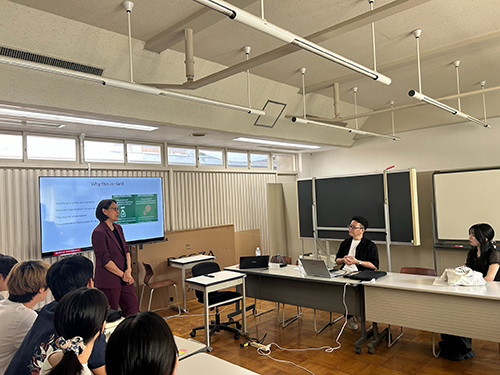
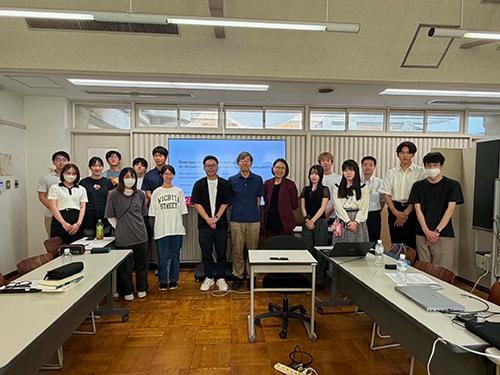
On June 30, 2026, the University of Shizuoka hosted a special lecture by Professor Valentina Zamora, Professor at Seattle University, titled “Do Universities Walk the Talk? An Accounting Lens on Nonprofits, Sustainability, and ESG.”
This lecture was made possible through the coordination of Professor Kojima of the School of International Studies at Kwansei Gakuin University. Participants included seminar students of Professor Ueno from the School of Management and Informatics at the University of Shizuoka, as well as graduate students taking related courses. High school students and students from other faculties also joined the session and actively participated in discussions in English.
Professor Zamora specializes in accounting, ESG, and sustainability. Her research focuses on corporate social responsibility disclosure, non-financial information, investor decision-making, corporate accountability, and sustainability education.
In her lecture, Professor Zamora discussed how accounting and reporting systems can be used to evaluate whether universities actually follow through on their sustainability commitments. In particular, she introduced the Sustainability Tracking, Assessment, and Rating System(STARS), a sustainability reporting and assessment framework for higher education institutions, and examined its adoption as a window into organizational priorities and behavior.
Although many universities publicly commit to sustainability, ESG principles, and the Sustainable Development Goals(SDGs), there remains variation in whether institutions adopt formal reporting systems and demonstrate accountability. The lecture addressed several central questions: Who reports? Why do some universities adopt sustainability reporting while others do not? What institutional pressures and incentives drive adoption? Is reporting associated with meaningful changes in behavior and outcomes?
Professor Zamora also introduced four key perspectives for understanding sustainability reporting: accountability, or a commitment to transparency and stewardship; legitimacy, or alignment with peer and societal expectations; strategic positioning, or signaling competitiveness and leadership; and resource dependence, or responding to donor and stakeholder pressures.
The lecture further discussed the concepts of greenwashing and greenhushing, emphasizing the importance of examining whether sustainability disclosure leads to actual organizational decision-making and behavioral change. Professor Zamora also explained her ongoing research approach, which uses panel data from multiple sources, including STARS, IPEDS, IRS, and others, to analyze the timing of adoption across institutions and compare outcomes before and after reporting adoption.
Following the lecture, participants exchanged views on sustainability initiatives at the University of Shizuoka. Students shared their experiences with support activities for other countries, while participating high school students introduced their project on water quality improvement.
This lecture provided a meaningful opportunity to consider the role of accounting and reporting systems in moving beyond sustainability commitments and embedding such priorities into concrete actions and decisions. It also allowed students to experience the importance of engaging in international dialogue in English.
On the following day, Professor Zamora also conducted fieldwork around the Shimizu area, deepening her understanding of the region’s characteristics from a comparative perspective with Seattle, another port city.
This lecture was made possible through the coordination of Professor Kojima of the School of International Studies at Kwansei Gakuin University. Participants included seminar students of Professor Ueno from the School of Management and Informatics at the University of Shizuoka, as well as graduate students taking related courses. High school students and students from other faculties also joined the session and actively participated in discussions in English.
Professor Zamora specializes in accounting, ESG, and sustainability. Her research focuses on corporate social responsibility disclosure, non-financial information, investor decision-making, corporate accountability, and sustainability education.
In her lecture, Professor Zamora discussed how accounting and reporting systems can be used to evaluate whether universities actually follow through on their sustainability commitments. In particular, she introduced the Sustainability Tracking, Assessment, and Rating System(STARS), a sustainability reporting and assessment framework for higher education institutions, and examined its adoption as a window into organizational priorities and behavior.
Although many universities publicly commit to sustainability, ESG principles, and the Sustainable Development Goals(SDGs), there remains variation in whether institutions adopt formal reporting systems and demonstrate accountability. The lecture addressed several central questions: Who reports? Why do some universities adopt sustainability reporting while others do not? What institutional pressures and incentives drive adoption? Is reporting associated with meaningful changes in behavior and outcomes?
Professor Zamora also introduced four key perspectives for understanding sustainability reporting: accountability, or a commitment to transparency and stewardship; legitimacy, or alignment with peer and societal expectations; strategic positioning, or signaling competitiveness and leadership; and resource dependence, or responding to donor and stakeholder pressures.
The lecture further discussed the concepts of greenwashing and greenhushing, emphasizing the importance of examining whether sustainability disclosure leads to actual organizational decision-making and behavioral change. Professor Zamora also explained her ongoing research approach, which uses panel data from multiple sources, including STARS, IPEDS, IRS, and others, to analyze the timing of adoption across institutions and compare outcomes before and after reporting adoption.
Following the lecture, participants exchanged views on sustainability initiatives at the University of Shizuoka. Students shared their experiences with support activities for other countries, while participating high school students introduced their project on water quality improvement.
This lecture provided a meaningful opportunity to consider the role of accounting and reporting systems in moving beyond sustainability commitments and embedding such priorities into concrete actions and decisions. It also allowed students to experience the importance of engaging in international dialogue in English.
On the following day, Professor Zamora also conducted fieldwork around the Shimizu area, deepening her understanding of the region’s characteristics from a comparative perspective with Seattle, another port city.

(7/9/2026)